What is epoxy flooring?
If you mix different polymer resins with hardening materials, the product is epoxy coating. Epoxy coating refreshes any type of floor surface, giving it shine and brightness, while making the floor smoother and less slippery.
Moreover, a space feels like it gets more light after the application of an epoxy coating. Businesses and homeowners can both apply concrete epoxy coating, as it has features that suit them both: stunning decade-long durability and a more-than-appealing visual finish.
Epoxy is not the only option when it comes to flooring products, but you should definitely consider putting it at the top of your list. Looking to stop water seeping into the surface underneath? Epoxy has that covered because it is spill-resistant and provides impermeability to different liquids, including water and chemicals.
More importantly, concrete epoxy coating does not favour germs; epoxy also offers antimicrobial properties. Marble floors offer elegance, grace and the hardiness of concrete — and these are the qualities epoxy coating adds to a space: beauty and the strength of marble.
Understanding epoxy floor coatings
Technically, there are three types of epoxy coating products: solvent-based, water-based, and pure solid epoxy. The market has also seen innovative products such as pre-tinted or metallic coatings.
Solvent-based epoxy
The oldest epoxy products are solvent-based: a combination of resin with high amounts of a solvent-based hardener. A short time after application, such epoxy releases toxic vapours. Put the safety of yourself or the operator you have hired at the top of your priorities — wear a proper respirator during and after application.
Water-based epoxy
Water-based epoxy delivers an identical shiny finish to solvent-based epoxy coating, without the need for a solvent hardener. Safety-wise, water-based epoxy products do not produce harmful post-drying vapour and provide a strong, non-toxic, spill-resistant surface.
Pure solid epoxy
Compared with water-based coatings, pure solid epoxy products — containing no water or solvent — offer better resistance to abrasion and chemical spills. The viscosity of a pure solid epoxy makes it impossible to apply a thin layer of coating, so you are better off calling a specialist to apply it.
Metallic epoxy
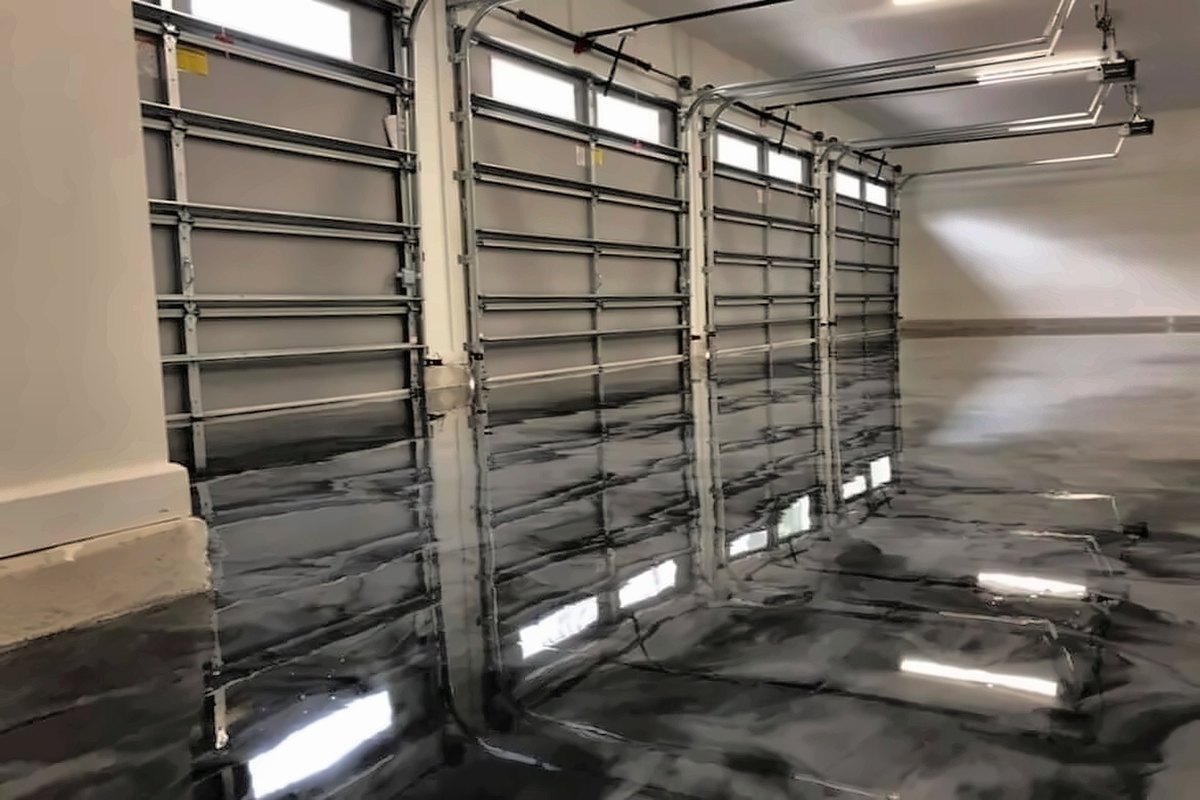
A metallic epoxy floor is multi-layered and, as the name suggests, contains an added metallic element. A roller or brush is used to spread the metallic pigments, which are then worked to obtain the “swirling effect.”
Epoxy flooring: advantages and disadvantages
Like any floor coating product, epoxy has its pros and cons. Consider these points to find out which product suits your flooring needs the most.
- Aesthetics: with its shiny finish, an epoxy-coated surface looks incredibly engaging, with a limitless range of colours to make the space more exciting and different.
- Resistance: epoxy flooring offers resistance to oil-based liquids, different types of gas, bleaches and many other chemicals — no worrying about stains if you spill a few drops of oil in your garage. Its antibacterial and antimicrobial properties make it a suitable choice for medical spaces such as hospitals.
- Longevity: applied by an expert, epoxy is known as a decade-long product with crack-resistant and peeling-resistant properties and high traffic tolerance.
- Semi-permanent: the exceptional longevity of epoxy also means that applying a new layer or updating an existing coating is costly and takes considerable time and labour.
Why should you pick epoxy coatings?
Whether you own a house and garage or run a business with exclusive office space, it is easy to neglect one of the most important dimensions of your space: the floor. The qualities a floor needs depend on the activity in the space — an industrial warehouse, for instance, requires a stronger, more solid floor with more slip resistance.
Epoxy is not only for garages or gyms. It can suit manufacturing, industrial and commercial spaces, and equally your home workshop, garage or basement. If you are a DIY enthusiast who moves things around the garage, seamless epoxy flake flooring is a smart investment.
1 — No-fuss maintenance
Stain resistance is one of the most talked-about features of epoxy flooring: liquid spills are easily dealt with by rinsing with water. An expert application makes sure all cracks are well coated, so bacteria and mould are tackled in advance — a well-coated surface supports the hygiene and safety of everyone using the space.
2 — High durability
A surface treated with epoxy can tolerate more pressure and a higher traffic rate, particularly from heavy machinery, materials and even dangerous chemicals. Common loads will not easily crack or chip an epoxy-coated surface.
3 — Cost-effective
Low maintenance costs make epoxy flooring an incredibly budget-friendly option in the long run. Compared with vinyl or hardwood, it avoids much of the extra cost of cleaning products and cleaning specialists.
Why epoxy is a premier garage floor coating
Epoxy offers one of the strongest, hardiest finishes for floors under harsh conditions, such as garages. It not only protects but gives your garage a stunning look in place of boring, cold-coloured concrete.
These days, our use of the garage is not limited to parking cars. With its resistant, durable and safety-related properties, epoxy is becoming more and more popular — perhaps the top choice — for garage flooring.
At Stonehard in Sydney, the colour range depends on the application: you can choose from a long range of solid colours and hues to custom colours and blends of colour flakes to find the ideal tone. You can even match your floor to your favourite team’s colours.
Explore epoxy garage flooring →
Epoxy flooring cost in Sydney
Epoxy flooring generally costs less than many other flooring options. As published on our original website, epoxy flooring cost in Sydney ranges from $803 to $5,272 for application and material, with the majority of Australian homeowners spending between $1,412 and $3,295.
For comparison, a standard epoxy finish has been quoted at around $AUD30 to $AUD35 per sqm, while a shiny finish can be about $AUD80 to $AUD100 per sqm. Vinyl tiles cost about $AUD40 to $AUD100 per sqm and ceramic tiles $AUD90 to $AUD125 or more.
If you choose a water-based epoxy product, you can save two to three times compared with a pure solid epoxy product. However, a solid epoxy is a choice with long life, optimal quality and minimum maintenance costs.
These figures are general market guides reproduced from the original STONEHARD website. Every floor is different — call our team for a free measure and an accurate quote for your space.